
Race, Belonging, and Performed Identity
Sonne und BetonThis thread examines how the boys use racial labels, ethnic affiliations, and social alliances to make sense of belonging, while the novel exposes the insecurity and prejudice embedded in those categories.
increasing Bearing strength in each event
 decreasing
Bearing strength in each eventdecreasingIdentity as Street Protection

Identity as Street Protection
A label chosen for safety
After being beaten, Lukas says he thinks the attackers might not have targeted him if he and Julius were not German. He also explains that, outside, he tells people he is Polish because he believes no one respects Germans in his neighborhood.
His claimed Polish identity is less an expression of cultural belonging than a defensive tactic. Lukas treats ethnicity as something that might alter how strangers classify him and whether they choose him as a target.
Protection built on anxiety
The tactic offers no certainty. Lukas does not have a strong connection to Poland, and he admits that the identity is partly self-protection. His performance makes visible how fear can turn identity into a tool for navigating an environment where he feels exposed.
The book does not make his perception a universal account of the neighborhood. It shows a teenager trying to explain his vulnerability through the categories available to him, even as those categories reproduce the divisions that make him anxious.
The Park’s Ethnic Lines
The Park’s Ethnic Lines
Speech as a marker of sides
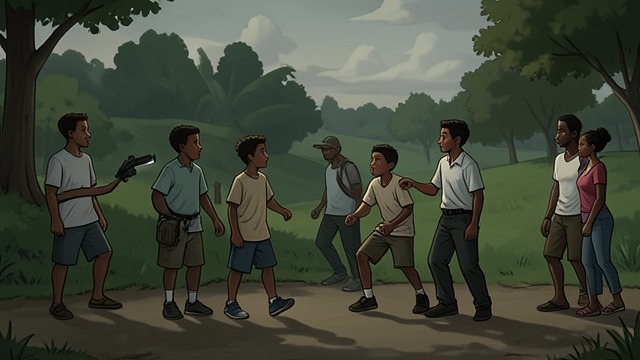
When Julius tells Djamel that the friends would not buy from “Turks,” Lukas pulls him back, recognizing that Julius’s attempt to distance them from one group insults another. He understands that the exchange could make them appear aligned with one side in a conflict they did not intend to join.
In the park, language does not stay casual. Ethnic labels and slurs rapidly become evidence of disrespect, and Djamel uses Lukas’s identity as a German to deepen the humiliation while attacking him.
The limits of belonging
Lukas’s association with Cem does not make him secure. Cem recognizes his brother Marco’s connections, calls Lukas a friend, and invites him into a retaliatory confrontation, but Lukas is still expected to prove himself by attacking Djamel.
The scene presents belonging as conditional: relationships can offer access and protection, yet the group can also demand participation in violence. Lukas is caught between the wish to be safe and the fear of being absorbed into someone else’s feud.
A Newcomer’s Self-Description
A Newcomer’s Self-Description
Moving between neighborhoods
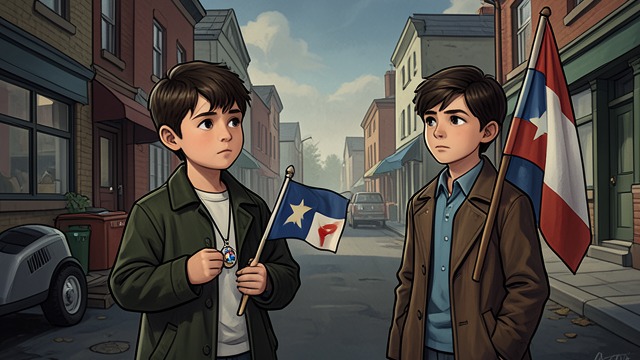
Sanchez has recently moved from Hellersdorf to Gropiusstadt with his mother. He describes the housing and atmosphere as familiar but different, then calls himself Cuban and shows Lukas a pendant with the Cuban flag.
Lukas, by contrast, says he presents himself as Polish outside despite having little connection to Poland. Their conversation makes identity seem flexible and situational: one boy names an inherited connection, while the other adopts a label he believes might help him survive.
Prejudice travels with them
Sanchez describes growing up as one of the only Black children in his former neighborhood and recalls being attacked by neo-Nazis. He says that life became easier after he met other Cubans and some Russians, showing how a community of allies can change the felt risks of a place.
His story complicates the assumption that the move to Neukölln simply means escape into safety. He has changed neighborhoods, but the experience of racism and the search for protection remain part of his life.
The School’s Racial Double Standard

The School’s Racial Double Standard
An adult recruits through prejudice
Herr Reinicke draws Lukas aside and claims that they must help one another as Germans. He assumes that students with immigrant backgrounds will protect each other and names them through racist slurs, while treating Lukas as the trustworthy exception because he is German.
The teacher uses the burglary investigation to flatter and recruit Lukas, offering him a role as an informant. His apparent alliance is not a principled search for truth but a bid to exploit racial suspicion for information.
The distortion of evidence
Lukas recognizes that the teacher’s assumptions are ugly, even as he sees that the bias might delay suspicion from falling on him. The moment makes him complicit in no simple way: he benefits from the prejudice while feeling its injustice.
The scene exposes how racism can warp institutions as well as street encounters. Herr Reinicke claims to defend order, yet his reasoning disregards evidence and treats students as racial blocs rather than individuals.
A More Complicated Welcome
A More Complicated Welcome
A family’s account of hostility
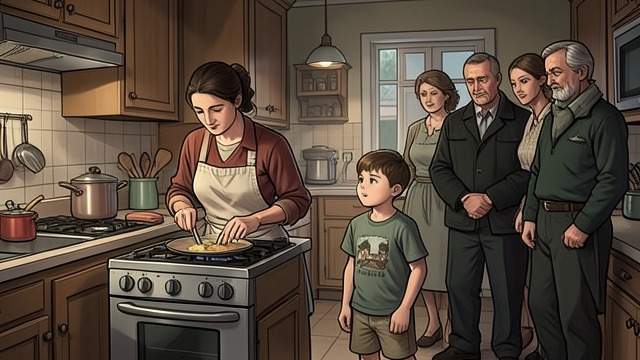
At Sanchez’s home, his mother, Gabi, tells Lukas about the racism she and her sons faced in Hellersdorf. Strangers followed them through a shop and shouted racist abuse, and she remembers turning to confront them even when they told her to leave.
Her recollection gives Sanchez’s earlier description a family history. The experience of being marked as outsiders began before the move and shaped how mother and sons understood their safety in public.
Belonging without erasure
Gabi says she appreciates that Neukölln has more immigrants and believes that local Nazis would not feel comfortable there. Her welcome is warm, and the meal she shares with Lukas offers a contrast to his assumptions that she and Sanchez’s family will feel alien to him.
The scene does not claim that a more diverse neighborhood resolves racism. Instead, it shows how the possibility of belonging depends on solidarity and everyday hospitality, while the family’s memories preserve the cost of exclusion.
After Lukas returns home from the park
During the confrontation with Djamel’s group
In Sanchez’s room, shortly after they meet
After the burglary, during Lukas’s meeting with Herr Reinicke
During dinner at Sanchez’s home
